
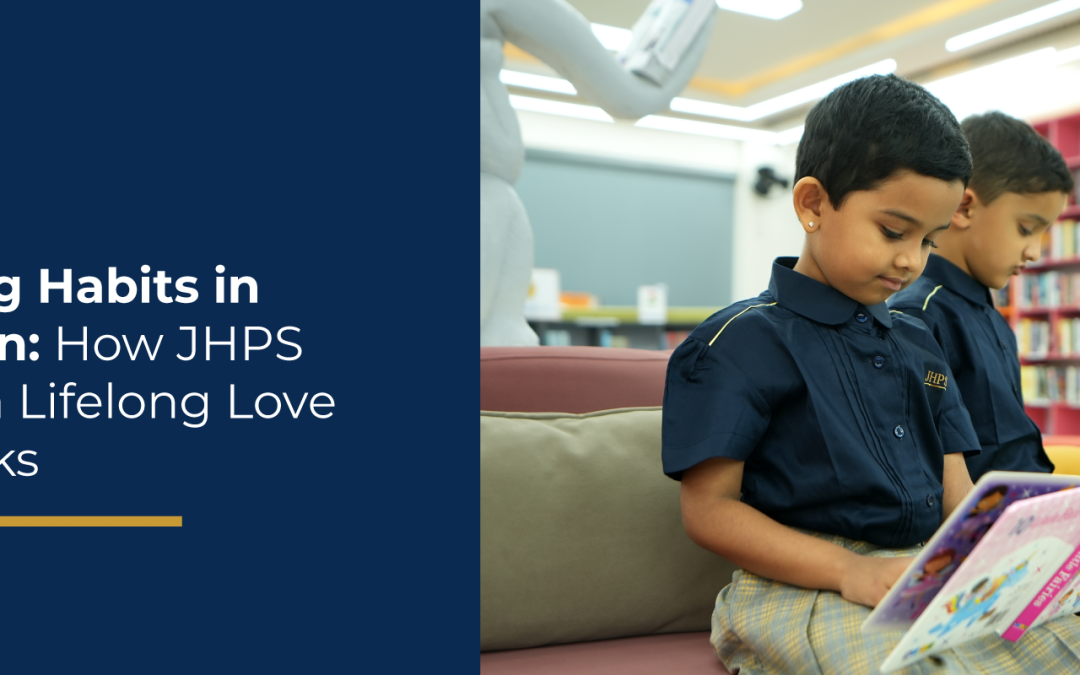
Every child reaches a pivotal moment in their reading journey when they move beyond recognising words and begin to truly read. It is the point where decoding gives way to understanding, curiosity, imagination, and the joy of becoming immersed in a story or discovering a new idea. Helping children reach this milestone is one of the most meaningful roles a school can play, as those who develop strong reading habits early are far more likely to remain lifelong readers rather than viewing books as merely another academic requirement.
At JHPS, this transformation is nurtured through a thoughtfully designed library ecosystem, the inquiry-led Cambridge curriculum, and a rich language and literature programme that inspires students to read with purpose and pleasure. Together, these elements foster a vibrant reading culture, encouraging children to become confident, curious, and independent readers both inside and beyond the classroom.
Why Reading Habits Matter More Than Reading Ability
A clear distinction between reading skill and reading habit needs to be made, since schools have often developed reading skills among children without consciously making efforts at building reading habits. A child can acquire the skill of reading the text well and answering reading comprehension questions as well as summarising the text properly, without acquiring the feeling of joy and satisfaction that comes from reading. The former is the case of a child who can read, whereas the latter describes a child who enjoys reading, and this is what the school needs to achieve.
The reading habits in children are developed in a manner that is most consistent when reading is consistently rewarded to the child intrinsically and not in an instrumental way. When the child is presented with an environment full of books that have been carefully selected by the parent and where the child makes his own choices, he develops a relationship with reading that will not need any coercion to continue. Building that environment is one of the things the school library JHPS and its accompanying programmes are specifically designed to do.
The Library at JHPS: Infrastructure Built Around Genuine Reading
JHPS Library is certainly not a repository of prescribed textbooks. This is because it consists of more than 20,000 books from different genres, a separate reference library for senior students and teachers, and a digital library which contains e-books and other online sources of information. In other words, JHPS has invested heavily in promoting the philosophy that reading is something that should take centre stage in school life, and not be relegated to its periphery. The diversity of the library collection alone is a crucial pedagogic message. A library consisting only of books related to the curriculum is a library that affirms the suspicion of children that reading is schoolwork.
This library is housed on the second floor of the Vishwam Edutainment Block, and this gives it physical respectability befitting the academic stature of the library. The library, designed properly with sufficient lighting and a feeling that conveys the worthiness of the activity going on in there, plays a more crucial role in developing the children’s relationship to it than a narrow, poorly equipped reading room can.
The digital library and e-book access extend this environment beyond school hours, allowing JHPS reading programme participants to continue their reading at home through the same curated ecosystem rather than dropping out of a reading flow the moment the school day ends. For families with limited access to diverse home libraries, this digital extension carries particular significance, ensuring that the reading culture built at school does not depend on home resources to sustain it.
How the Cambridge Curriculum Supports Reading Development
The Cambridge approach’s connection with language and literature is unique in its own way, and an understanding of this helps explain why the JHPS Cambridge curriculum delivery produces better readers compared to curricula that are largely based on comprehension questions. In the Cambridge International approach, reading is not considered a skill that needs to be tested using short-answer questions; rather, it is seen as a process of inquiry and making sense.
Phonics, vocabulary, and reading skills are acquired in Early Years through stories, discussions, and imagination; therefore, reading becomes a joyful activity associated with pleasure and interest as opposed to performance and evaluation. Reading gains a whole new level of meaning in Cambridge Primary Years because it is created to be connected to creative writing, critical thinking, and research skills, and students are expected to correlate reading material with their own ideas and thoughts, not simply repeat what was said in the text.
This approach regards reading habits in children both as an academic discipline and as a personal one, understanding that a child who is able to read a lot and with passion will automatically acquire such skills as vocabulary building, understanding, and analysis as a result of real engagement, not just skill training.
The Story Box, Library Activities, and Structured Reading Engagement
Beyond simply providing access to books, JHPS structures active engagement with reading through dedicated library activities, a Story Box initiative, and new arrivals displays that keep the library’s collection visibly alive and current rather than static and familiar. These structural choices reflect an understanding of building reading habits in kids that goes beyond provision to active cultivation.
Story Box, in particular, sees storytelling itself as an educational activity because it understands that the move from stories told to stories read is greatly facilitated by an oral storytelling tradition that exists before and during early reading ability. Children who have been exposed to stories as something truly engaging will bring an entire attitude of expectation when approaching books, whereas those who have only learned reading as a skill simply lack.
Library programs provide the students with opportunities to connect with the library as a lively place rather than as a repository that one must visit when a particular book has been assigned to them. If the library becomes a place where conversations are held, things are discovered, and literary passion is shared, then it acquires a social aspect of reading, which makes it a habit not only because of individual disposition but due to peer influence as well.
What the Cambridge Curriculum Includes in Terms of Literature
Does the Cambridge curriculum include literature studies? is one of the most common queries that parents ask, especially when comparing the Cambridge curriculum to other boards, which they feel have an enhanced literary component. The Cambridge Primary curriculum ensures that literature forms an integral part of language arts lessons, and not an isolated one. Children enrolled in the Cambridge Primary curriculum get to work on a variety of literary pieces such as fiction, poetry, nonfiction, and informative texts.
Such an approach is especially vital in instilling solid reading habits in children, because a child who has been brought up reading nothing but fictional narratives might start to develop a reading habit that gradually becomes restricted due to their lack of familiarity with other kinds of texts. A curriculum that teaches a child to read comfortably other kinds of literature apart from fiction creates a more flexible reader in the end.
How Parents Can Support Reading Habits Developed at School
A school’s reading programme is most effective when it finds a genuine partner at home, since the hours available for reading outside school dwarf those available within it. Parents who want to reinforce the JHPS reading programme work happening at school are not simply being asked to ensure homework is done; they are being invited into a shared project of building a child’s identity as a reader.
The most effective forms of parental engagement are never prescriptive, asking a child to do a certain book and hand in a report. Rather, they are interactive: reading with a child, discussing books as engaging objects in themselves rather than useful academically, and accompanying visits to bookshops or sections of libraries with enthusiasm rather than with reluctance. If a child is exposed to parents reading and being interested in what they are reading, and if the books become associated with things of value to grown-ups, then they are likely to acquire an attitude to reading which cannot be achieved by schools alone.
When one asks specific questions regarding what books the child is reading now, who their favourite characters are, their favorite characters and why they like them, and if they want to recommend any book to their parents, reading becomes a communicative activity instead of a solitary and individual one.
Recommended Reading Approaches for JHPS Primary Students
Rather than recommending specific titles, the best advice for parents of primary school students at JHPS is to focus on encouraging diversity, choice, and abundance in reading materials. Children who explore a wide variety of books, choose what they want to read, and engage with reading in a relaxed, enjoyable manner are more likely to develop strong, lifelong reading habits.
The JHPS library’s extensive collection across multiple genres, combined with the Story Box initiative and curated new arrivals displays, gives students regular exposure to a diverse range of reading opportunities. Parents who build on the interests their children develop at school, rather than directing them solely towards what they believe to be more appropriate reading material, are more likely to nurture a lasting love for reading than create friction in what is naturally an intrinsically motivated process.
At JHPS Global Learning, our Cambridge curriculum integrates reading as a daily, cross-disciplinary practice rather than treating it as a standalone subject. This approach is supported by a 20,000-book library, Story Box initiatives, engaging library programmes, and digital access to e-books that extends learning well beyond the school day. We believe that building a genuine reading culture in Hyderabad schools begins with providing children with the right environment, a wide variety of texts, and the freedom to explore at their own pace. Our library is not simply a place we ask students to visit; it is a space designed to inspire them to return, again and again.
Frequently Asked Questions
How does JHPS encourage reading habits in children?
JHPS supports reading through a 20,000+ book library across all genres, a Story Box initiative, active library programmes, digital and e-book access, and a Cambridge curriculum that integrates literature across Early Years and Primary instruction rather than treating reading as an isolated skill.
What is the reading programme at JHPS Hyderabad?
The JHPS reading programme encompasses structured library activities, the Story Box initiative, new arrivals engagement, and digital library access, all designed to build reading as a genuine, self-sustaining habit rather than a school obligation completed and abandoned when no longer required.
How can parents help children build a love for reading?
Reading alongside a child, discussing books as genuinely interesting rather than academically prescribed, following a child’s own reading enthusiasms, and visiting libraries or bookshops with genuine enthusiasm all reinforce the reading culture built at school in ways that assignment-based reading encouragement typically cannot match.
Does the Cambridge curriculum include literature studies?
Yes, the Cambridge Primary curriculum integrates fiction, poetry, non-fiction, and informational texts throughout language arts instruction, building a versatile reader comfortable across different text types and purposes rather than limiting literary exposure to a single genre or format.
What are some recommended books for JHPS primary students?
Rather than prescribing specific titles, JHPS encourages students to explore the full breadth of the library’s 20,000-book collection across genres, following their own curiosity and enthusiasm under the guidance of library activities and teacher recommendations, since intrinsically motivated reading choices tend to sustain the reading habit most reliably over time.