
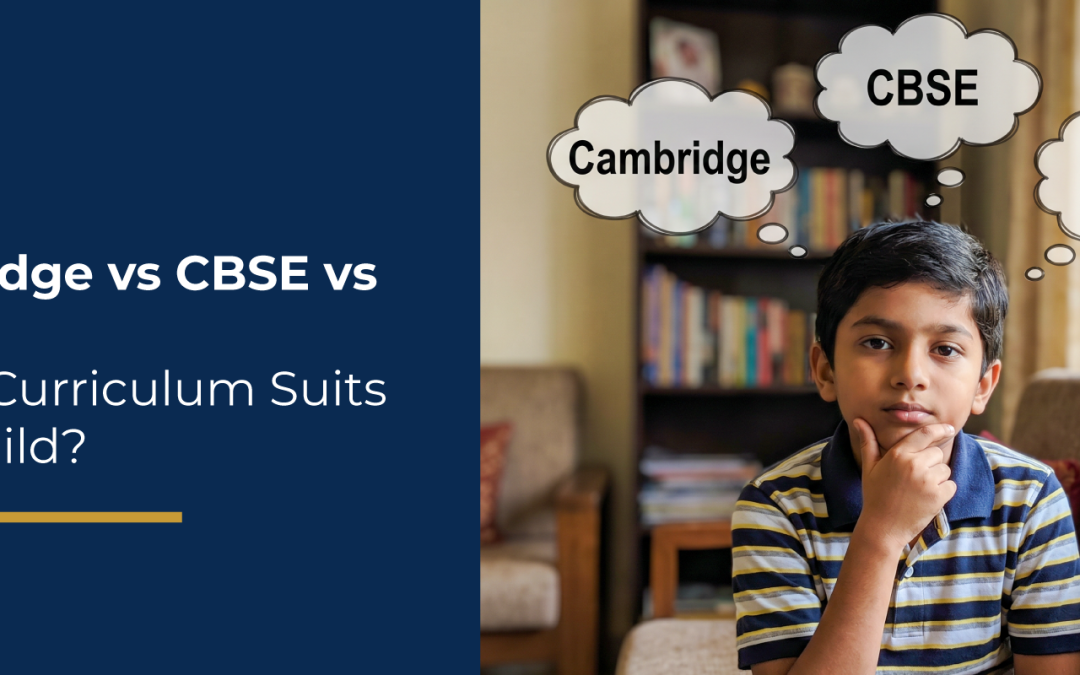
Choosing a school should be one of the most exciting decisions a parent makes. Yet, for many, it quickly becomes one of the most overwhelming.
It starts with a simple question: which board is right for your child? Soon, that one question turns into many. Advice comes from every direction—relatives, friends, online forums, and schools, each promising the best future.
Before you know it, you’re comparing Cambridge, CBSE, and ICSE, trying to find the path that truly fits your child.
The funny thing is that every curriculum sounds convincing when someone is explaining it. That can make the decision feel even harder. Somewhere in the middle of all that information, it becomes easy to forget that this is not really about choosing a board. It is about choosing the kind of learning a child will live with for years. That feels like a much bigger decision.
Every Curriculum Tells a Different Story
People often compare school boards as though they are competing with one another. In reality, they are not. Each has been designed around a distinct philosophy of education. One may place greater emphasis on structure, while another may encourage deeper exploration and understanding. Neither approach is inherently right or wrong.
Children are different too. Some thrive when they know exactly what comes next. Others flourish when they are encouraged to ask questions, even if the answers are not immediate. Most, however, fall somewhere in between. That is why a school board alone can never determine how successful a child’s learning journey will be.
Why Many Families Still Choose CBSE
CBSE has been a familiar name for years, and there is comfort in familiarity. Its curriculum follows a clear structure, especially in subjects like Mathematics and Science. Lessons usually build one after another in an organised way, which works well for children who enjoy routine and steady academic progress.
Many parents also feel reassured because CBSE connects comfortably with several national entrance examinations later on. When conversations turn towards the difference between CBSE and ICSE, this is often where they begin. CBSE is generally seen as focused, structured, and consistent across schools. For many children, that kind of clarity works really well.
ICSE Looks At Learning a Little Differently
ICSE often feels broader. Along with academics, it gives space to languages, literature, arts, and detailed understanding. Children are encouraged to express ideas instead of simply arriving at the correct answer.
Some students enjoy that because learning feels like something to understand instead of something to finish. The difference between ICSE and CBSE is sometimes less about the subjects themselves and more about how those subjects are experienced every day. That small shift can make a surprisingly big difference depending on the child.
Cambridge Begins with Curiosity
The Cambridge Curriculum feels different almost from the beginning. Questions are welcomed. Discussions become part of learning. Children are encouraged to understand ideas instead of memorising them simply because they may appear in an examination. There is something quite natural about that approach.
After all, children ask questions long before they enter school. Good education probably should not make them stop asking. When parents look at the difference between Cambridge and CBSE, this is often what stands out. Cambridge gives equal importance to academic learning and to the ability to think independently, solve problems, communicate clearly, and work with others. Those are qualities that quietly become useful far beyond school.
The Right Choice Usually Looks Different for Every Child
This is probably the part that makes the decision difficult. There is no curriculum that fits every learner perfectly. One child may enjoy clear routines and familiar patterns. Another may become more confident in classrooms where curiosity leads the lesson. Some children need more guidance. Others enjoy figuring things out as they go.
That is why comparing school boards only on reputation rarely tells the full story. The child almost always completes the picture.
Why We Built JHPS Global Learning This Way
At JHPS Global Learning, this was something we kept coming back to while shaping our learning environment. For nearly four decades, Jubilee Hills Public School has stood for quality education. As the world around education continued changing, we felt children also needed a learning experience that prepared them for life beyond examinations.
That belief became JHPS Global Learning. We chose the Cambridge Curriculum because it encourages children to stay curious, think independently, and understand the world instead of simply collecting information about it.
Learning begins gently through our Cambridge Early Years programme, where children build early habits, confidence, and essential skills in a caring environment. As they move into Cambridge Primary, those early questions gradually become deeper conversations, creative thinking, and meaningful learning.
At JHPS Global Learning, we try to make learning feel alive every day. Our STEM and Robotics Labs, dedicated Space Lab, Innovation and Maker’s Lab, smart digital classrooms, modern library, creative arts studios, sports facilities, and activity spaces all exist for the same reason. Children understand more when they experience learning instead of only reading about it.
We also know that no two learners are exactly alike. Our teacher-student ratio allows every child to receive individual attention while growing academically, emotionally, socially, and creatively. Assessments are designed to reflect that journey through projects, discussions, presentations, portfolios, reflections, and continuous learning rather than relying only on examinations.
For us, education has never been only about marks. It has always been about helping children become thoughtful, capable, and confident people.
Maybe the Better Question is Different
Parents often ask, which board is best for my child? It makes sense. It is probably the question everyone asks at some point. But after spending enough time understanding different curricula, another question quietly appears.
What kind of learner is this child becoming? Sometimes that question makes the answer feel much clearer than comparing syllabi ever could.
Final Words
Choosing between Cambridge vs CBSE vs ICSE is not really about finding the board with the strongest reputation. It is about finding a place where a child enjoys learning enough to keep asking questions, making mistakes, discovering strengths, and growing into someone who feels confident about the future.
That is exactly what we hope to build every day at JHPS Global Learning. Because long after school ends, children may not remember every lesson they studied. There is a good chance they will remember how learning made them feel. And that feeling has a way of staying with them for a very long time.