
Changing schools in the middle years can feel bigger than it looks on paper. A child may simply move to another classroom, meet new teachers, and start using different books. But underneath that, the way learning happens may also change.
For parents, the questions are understandable. Will the child adjust? Will studies become harder? Is it too late to change?
The truth is, switching from CBSE to the Cambridge curriculum is not necessarily about studying more. It is more about studying in a different way. The difference may not be obvious in the first few days. It usually becomes clearer once the child settles into the new routine.
Why Middle School Can Be A Good Time
Middle school is already a period of change. Subjects become more detailed, children become more independent, and they slowly start understanding what they enjoy.
That is why parents often ask about the best age to switch from CBSE to Cambridge. There is no single answer for every child. Still, these years can work well because children are old enough to understand a new learning style while still being flexible enough to adapt.
The beginning may feel strange. Some children enjoy the change immediately, while others miss their old school and familiar routines. Both reactions are quite normal.
The Classroom Feels Different
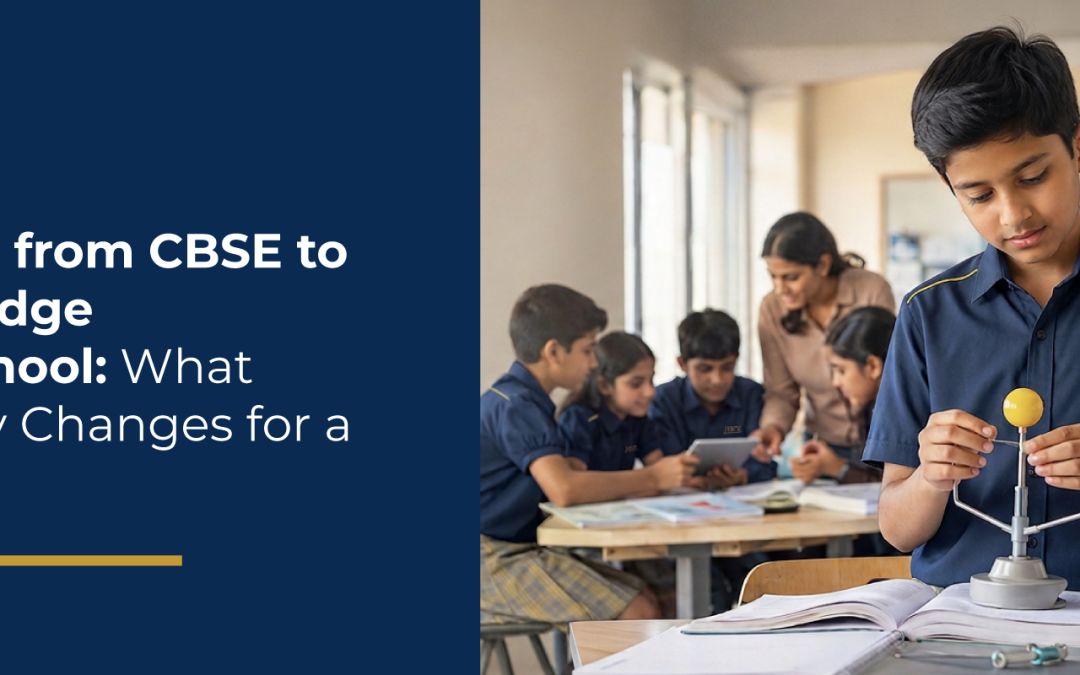
One of the first things children notice is how lessons are conducted. A CBSE classroom may follow a more structured pattern of explanation, practice, and revision. Cambridge learning can leave more room for discussion, questions, and exploration.
Instead of simply waiting for the teacher to give the answer, children may be asked why they think something is correct or how they reached a conclusion.
This is an important part of the CBSE vs Cambridge curriculum difference. The focus is not only on knowing something but also on understanding it and being able to explain it.
At JHPS Global, we support children as they gradually become comfortable with this approach.
Homework May Look Less Repetitive
Doing homework may also seem different from before. While they will no longer have to solve many problems that are alike in nature, they may have to analyse some concept, do some research, observe events around them or follow up on their classwork.
For a child used to straightforward homework, this can take some getting used to.
During the CBSE to IGCSE transition, parents may also wonder why a particular activity is being given instead of more written practice. In many cases, the purpose is simply to make the child think about the topic rather than repeat it.
English Focuses More On Expression
English is another area where the change may become noticeable. Children may read different types of texts and talk about what they understood, what they noticed, or what they think about a particular idea. Grammar and vocabulary still matter, but expressing thoughts clearly matters too.
For some children, writing in their own words can feel uncomfortable at first. They may look for a fixed answer because that is what they are familiar with.
With time, they can become more comfortable expressing an opinion instead of trying to reproduce one expected response.
Exams Are Not The Only Measure
Parents naturally keep an eye on marks, especially after a school change. Cambridge assessment, however, can involve more than traditional tests. Projects, classroom work, presentations, practical activities, and written responses may all have a place in learning.
This can be useful for children who understand concepts well but do not always perform at their best in one examination. It also teaches children that learning is not limited to what happens during an exam.
Children May Become More Curious
Perhaps the quieter change is in the way children approach questions. Some may start to question more with “why” and “what if.” Some may make connections across different topics or feel more comfortable admitting that they don’t yet know something.
Not all children will do this right away. Some may require time to build confidence to express their views. Inquiry-based learning at JHPS Global enables children to ask questions, develop ideas, and become increasingly independent learners.
Parents Have To Adjust Too
The change is not only for children.
Parents who are familiar with CBSE may initially find Cambridge assignments, projects, and assessments unfamiliar. It is easy to compare every new activity with the old system.
That comparison can make the transition seem more complicated than it is.
It may be more useful to watch how the child is settling over a few months. Are they understanding lessons? Are they becoming more confident? Are they beginning to participate?
Those things often tell a better story than one homework sheet or one test result.
What We Offer At JHPS Global Learning
At JHPS Global Learning, we understand that moving into the Cambridge curriculum is a change for both children and parents. With the legacy of Jubilee Hills Public School behind us, we bring nearly four decades of educational experience into a global learning environment. We foster inquiry, creativity, independent thinking, and participation, and provide individual attention to the children.
Learning is not limited to books but also involves STEM, robotics, AI, space lab, arts, sports, leadership, and wellness programs. We want children to feel supported while they adjust, rather than feeling that they have to understand everything immediately.
Give The Change Some Time
The first few weeks rarely tell the whole story.
A child may find the classroom strange, miss old friends, or feel unsure about unfamiliar homework. That does not automatically mean the change is not working.
As routines become familiar, things usually begin to settle. Children get to know their teachers, make friends, understand expectations, and slowly stop comparing everything with their previous school.
That is often when the real adjustment begins.
A Different Way Of Learning
The switch from CBSE to Cambridge curriculum is not simply a change of books or school routines. It can change how a child approaches questions, completes work, and expresses ideas.
The CBSE vs Cambridge curriculum difference may feel noticeable at first, while the CBSE to IGCSE transition can take some patience from everyone involved.
And when parents ask about the best age to switch from CBSE to Cambridge, there may not be one perfect answer. What matters more is whether the child has the support and time needed to settle into something new. A different curriculum does not have to mean an overwhelming change. With the right environment, it can simply become a different way for the same child to learn.