Jubilee Hills, Hyderabad
 Tradition, Technology, Transformation


16 October 2026
Cambridge IGCSE Explained: What It Is And Why It's Valued
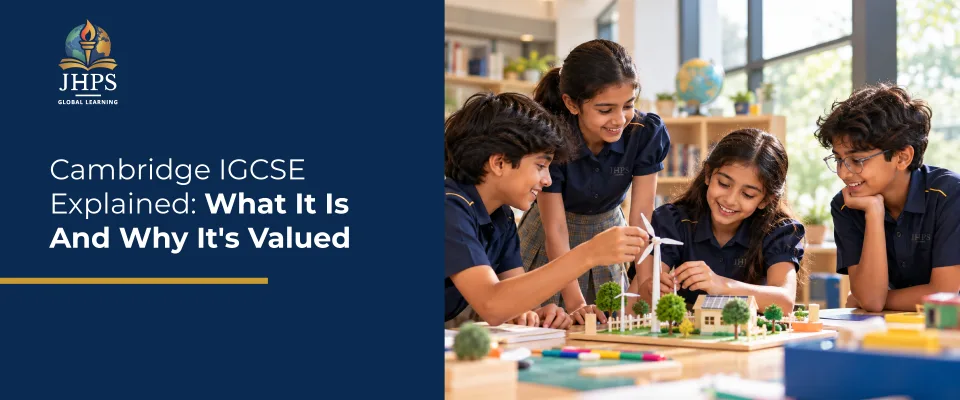
Choosing a school board sounds simple until the search actually begins. There are so many options, and every curriculum seems to offer something different. Parents hear about Cambridge IGCSE, look it up, and soon find themselves trying to figure out what makes it worth considering.
IGCSE stands for International General Certificate of Secondary Education. It is a qualification offered by Cambridge International Education, usually taken by students between 14 and 16 years old.
But the name alone doesn't tell parents very much, does it? What really matters is what happens in the classroom. How are children taught? Are they encouraged to ask questions? Do they understand a subject, or are they mostly trying to remember enough to get through an exam?
The Cambridge IGCSE programme places importance on understanding and applying knowledge. Students still have lessons, homework and examinations, of course. The difference is that learning can involve questioning ideas, working through problems, and looking at a topic from multiple angles.
A Closer Look At The IGCSE Curriculum
The subjects offered in the IGCSE curriculum include mathematics, science, languages, humanities, and many other subjects. Students are therefore able to have a general knowledge of all the subjects and not specialise in one.
The classroom experience can be quite interesting, depending on how a teacher approaches a lesson. A science topic, for instance, might involve an experiment. An English lesson could ask students to explain what they think a passage means rather than simply repeat what is written in a textbook.
Not every lesson will be hands-on, and children will still have plenty to study. No curriculum can make every subject easy or enjoyable all the time.
What matters is that students get opportunities to understand what they're learning. When a child starts asking why something works instead of only asking what to memorise, learning begins to feel a little different.
At JHPS Global Learning, we encourage children to explore ideas, ask questions and build confidence through active learning.
Why Do Families Look At The IGCSE Board?
For many parents, the global recognition of the IGCSE board becomes an important factor in considering it. Qualifications of Cambridge IGCSE are recognised in numerous schools and universities around the world, although each institution has its own entry criteria.
This may help people planning to pursue further education abroad or those who might move in the future. Moreover, the course can help students gain experience working independently and finding solutions to problems.
Still, recognition isn't everything. A qualification can be widely accepted, yet it may not be the right fit for every child. Some students enjoy exploring questions on their own, while others need more structure and regular guidance to feel comfortable.
Both are perfectly normal.
Before choosing a board, it makes sense to look at the school experience itself. Are teachers approachable? Can students ask for help when they fall behind? Is there room for activities outside the classroom? These everyday details can matter just as much as the curriculum itself.
What Should Parents Know About The IGCSE Syllabus?
The IGCSE syllabus sets out what students need to learn in each subject. It gives teachers a framework to work with and helps students understand what they are expected to know.
Assessment methods differ between subjects. Some involve written examinations, while others may include practical work or coursework. So, a student might need to explain a scientific concept in one subject and demonstrate a practical skill in another.
There is some responsibility involved here. Students need to keep up with lessons, practise regularly and ask for help when something doesn't make sense. Waiting until the examination is around the corner can make things unnecessarily stressful.
And not every child understands a topic at the same speed. Sometimes an explanation needs to be repeated. Sometimes a different example makes everything click. Having teachers who recognise this can make a real difference to how children feel about their studies.
Which Subjects Can Students Choose?
Parents often want to see the available IGCSE subjects list before making a decision. It may include English, mathematics, biology, chemistry, physics, geography, history, languages, business studies, art and computer science.
Choices aren't identical at every school, so it's important to check what's actually offered.
Subject selection can be a funny thing. A child who has always enjoyed drawing might suddenly become interested in computer science. Someone who finds mathematics difficult may discover that they enjoy biology. Interests change as children learn more about the world, and that's quite natural.
Of course, choices shouldn't be made on interest alone. If a student is thinking about medicine, engineering or another specific university course, it is sensible to check the subjects and qualifications needed for admission.
Teenagers don't need to have every future decision figured out. A little planning, though, can prevent unnecessary problems later.
Is It Only About Getting Good Marks?
Examinations are part of school life, and good results can open doors. But learning is more than the marks on a report card.
Think about a student who can explain why an answer is correct. That student may find it easier to deal with a question that looks unfamiliar. Someone who has practised researching a topic may also feel more comfortable working independently.
These abilities take time to develop. They depend on teachers, classroom experiences and the willingness to keep trying when something feels difficult. Following a particular curriculum doesn't automatically make a student independent or confident.
At JHPS Global Learning, we support classroom learning with STEM activities, robotics, practical experiences and opportunities to explore different interests. We want children to have space to discover what they enjoy while continuing to build their academic skills.
Is Cambridge IGCSE The Right Choice For Your Child?
This is probably the question that matters most, and there isn't one answer that works for every family.
Some children like discussing ideas and finding their own way through a problem. Others feel more comfortable when a teacher explains things step by step. Most need a mixture of both, depending on the subject and the situation.
The Cambridge programme has its own academic expectations, and students need to be prepared to put in regular effort. Parents should understand the workload, assessment methods and available subjects before deciding.
A school visit can help bring all of this into perspective. Instead of looking only at classrooms and facilities, spend some time asking about teaching methods and student support. Notice how teachers speak to children. Ask what happens when a student struggles with a lesson.
For families comparing IGCSE schools in Hyderabad, these small details can make the decision easier. A school should feel like a place where a child can learn, ask questions, and gradually become more independent.
Learning At JHPS Global
At JHPS Global Learning, we bring nearly four decades of educational experience from Jubilee Hills Public School into our Cambridge learning environment. We want children to feel that learning is something they can take part in, not just something they have to complete. Through our Cambridge Early Years and Cambridge Primary Years programmes, we encourage curiosity, creativity and active participation from the early stages of schooling.
We also provide modern classrooms, a library, STEM and robotics labs, a dedicated Space Lab and facilities for sports and creative activities. We recognise that not all children learn alike, and we value the chance to support them in different ways, based on their needs and interests. For us, the goal of schooling is to build a solid foundation, learn useful skills, and feel comfortable questioning, making mistakes, and trying again.
Final Thoughts
Cambridge IGCSE is worth exploring for families who want an international curriculum that encourages students to understand what they learn and use that knowledge in different situations.
But choosing a board shouldn't be about following what everyone else seems to prefer. The curriculum, teachers, and school environment all deserve a closer look. Once parents understand how these pieces fit together, the decision often becomes less confusing. That's a much better place to start than choosing a school simply because its name sounds impressive.
Related Blogs

16 October 2026
Admission Process For Cambridge Schools In Hyderabad: Age Criteria, Documents, And TimelineContinue Reading
30 September 2026
Cambridge Primary vs Cambridge Lower Secondary: What Changes for Your Child?Continue Reading