
There is something fascinating about the way children learn. It almost never happens in a straight line. Some days, everything makes sense. On others, the same child who answered every question yesterday may struggle with something that seems much simpler. That does not always mean learning has stopped. Sometimes, it is simply taking a different route.
That is perhaps why assessment has become such an important conversation. Not because children should constantly be tested, but because the way schools measure progress quietly shapes the way they experience learning itself. It is also one of the reasons many parents begin exploring Cambridge curriculum assessment. The approach feels different from what most of them remember growing up.
Learning is Bigger Than a Report Card
For a long time, assessments have almost been treated like the finish line. Children study for weeks, write an exam, receive a mark, and move on to the next chapter. It feels familiar because most people have grown up with that system.
But learning rarely works that neatly. A child may finally understand a difficult idea during a classroom discussion instead of an exam. Another may discover confidence while presenting a project even if written tests still feel difficult. Those moments matter too, even though they cannot always be measured with a number. That is where Cambridge begins to look at assessment a little differently.
Two Ways of Understanding Progress
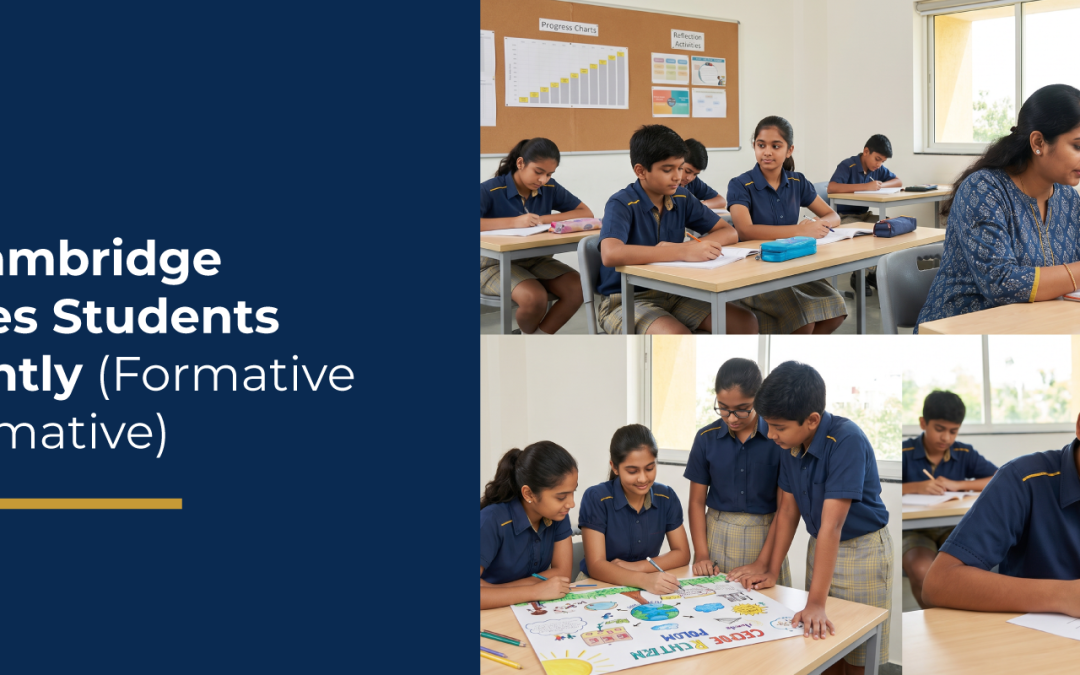
The phrase formative vs summative assessment sounds technical at first. Once it is understood, though, it feels surprisingly simple. Formative assessment happens while children are still learning. Teachers observe discussions, projects, classroom activities, portfolios, and everyday participation. The purpose is not really to judge performance. It is to understand where support is needed before learning moves forward.
Summative assessment comes later. It may be through tests, presentations, or term-end evaluations that help understand what students have learned after completing a topic.
Neither one tries to replace the other. One helps children while they are learning. The other helps measure what they have learned. Both have their place.
Small Moments Often Tell a Bigger Story
Sometimes people think assessments only happen when answer sheets appear. That is not always true.
A teacher noticing how confidently a child explains an idea to classmates is learning something. Watching students solve a problem together says something too. Even listening to the questions children ask during a lesson can reveal how deeply they understand a topic. These moments are quiet.
Most parents never see them. But they slowly build a much fuller picture of each learner than one examination ever could. That is one of the ideas behind the Cambridge assessment methods. Progress is observed continuously instead of waiting until the end of the term.
Children Learn Better When Every Mistake Does Not Feel Final
There is probably less fear in learning when children know every mistake is not being counted against them. They become more willing to try new ideas. They ask questions more freely.
Sometimes they even discover answers by getting something wrong first. That changes the classroom in small ways. Learning becomes less about avoiding mistakes and a little more about understanding why something works. It is difficult to measure that feeling, but it often stays with children much longer than a mark on a report card.
Why We Believe in This At JHPS Global Learning
At JHPS Global Learning, this is something we think about every day. We believe children deserve an education that prepares them for life, not only for examinations. That belief is one of the reasons we chose the Cambridge Curriculum as part of our journey after nearly four decades of educational excellence through Jubilee Hills Public School.
At JHPS Global Learning, learning begins with curiosity. From our Cambridge Early Years to Cambridge Primary, we encourage children to understand, reflect, ask questions, and slowly build confidence in their own thinking. Because of that, our assessments are never limited to one examination.
We use formative assessments through classroom discussions, projects, portfolios, observations, and everyday learning experiences. Alongside these, we also conduct summative assessments through tests, presentations, and term-end evaluations. Reflection and self-evaluation are equally important because children gradually begin understanding their own progress instead of only waiting for marks.
We also know every learner grows differently. Our teacher-student ratio allows us to understand every child more personally while supporting them through individual guidance. Whether children are learning inside our STEM and Robotics Labs, understanding ideas in our Space Lab, creating in our Maker’s Lab, reading in our library, or expressing themselves through art, music, and sports, every experience becomes part of their learning journey.
For us at JHPS Global Learning, assessment is not something separate from education. It grows alongside learning itself.
Looking Beyond Marks
Marks will probably always matter. They help schools understand progress, and they help parents see how children are doing academically. But they do not always tell the whole story.
Confidence rarely appears beside a percentage. Curiosity does not receive a grade. Kindness, creativity, teamwork, and resilience usually develop quietly over time. Good education notices those things too.
That is why many parents searching for how Cambridge schools assess students are often surprised to see how much importance is given to the learning process itself, not only to the final outcome.
What We Hope Every Child Carries Forward
At JHPS Global Learning, we often feel that the purpose of assessment is not simply to measure children. It is to understand them. Every classroom discussion, project, presentation, activity, and reflection gives us another opportunity to see how a learner is growing.
Along with academics, we continue building confidence through innovation, creativity, leadership, emotional well-being, and practical learning supported by our smart classrooms, modern facilities, Robotics Labs, Space Lab, sports programmes, and creative spaces. That balance between academic excellence and personal growth is something we continue working towards every single day.
Final Words
Perhaps that is the biggest difference. The Cambridge curriculum assessment approach does not treat learning as something that begins before an exam and ends after it. It sees learning as something that keeps moving.
Children keep asking questions. Teachers keep guiding them. Confidence keeps growing. At JHPS Global Learning, we believe that is how education should feel. Not like preparing for one important day, but like slowly becoming someone who enjoys learning long after school is over.